



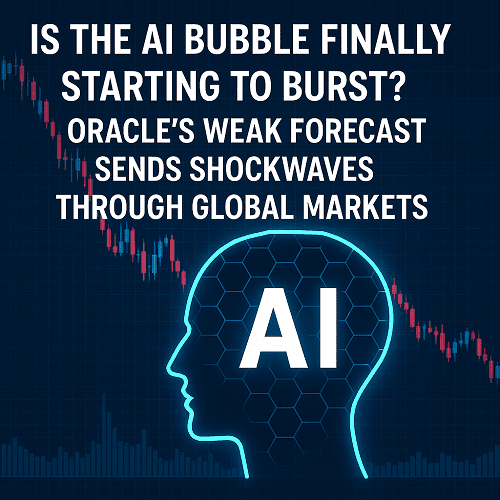
Is the AI Bubble Finally Starting to Burst? Oracle’s Weak Forecast Sends Shockwaves Through Global Markets
The artificial intelligence boom that has powered U.S. equities for nearly two years may have hit its first real stress test. Oracle Stock’s softer-than-expected revenue forecast has rekindled fears that AI valuations — stretched to historic extremes — are no longer supported by near-term earnings reality.
The reaction was swift: tech futures slid, Nasdaq turned lower, and risk assets including crypto followed suit. For many traders, this wasn’t just another earnings miss — it was the first meaningful signal that the AI trade may be losing altitude.
In this comprehensive analysis, we break down:
- Why Oracle’s guidance triggered AI bubble anxiety
- How current AI valuations compare to the dot-com era
- What this means for stocks, crypto, and forex traders
- Key indicators to track if the AI bubble is indeed deflating
- Actionable strategies for navigating the next phase of the AI cycle
Oracle’s Forecast: The Spark That Ignited AI Bubble Fears
Oracle’s disappointing outlook did more than rattle shareholders — it shook confidence in the entire AI infrastructure sector.
Why the market reacted so aggressively
- AI revenue expectations were sky-high.
Oracle has been positioning itself as a major AI infrastructure provider. A slowdown suggests enterprise AI spending may be softer than the market priced in. - Capex-heavy AI models require enormous investment.
Investors now fear that companies have overextended, building capacity ahead of demand — similar to the fiber-optic overbuild of the early 2000s. - High expectations meet early-cycle growing pains.
When valuations price in near-perfect execution, any deviation triggers outsized repricing.
Immediate market impact
- Nasdaq futures fell as the AI megacap complex pulled back.
- Risk appetite across sectors cooled sharply.
- Tech leadership — particularly AI server, chip, and cloud names — began to lose momentum.
Oracle didn’t just have a bad night — it opened the door to a conversation Wall Street has been trying to avoid:
What if AI growth doesn’t accelerate linearly?
Are We in an AI Bubble? How Today’s Market Compares to the Dot-Com Era
AI optimism has driven one of the fastest market repricings in history, but the question remains: Is the AI sector a bubble or a sustainable growth story with temporary volatility?
Similarities to past bubbles
- High valuations untethered from near-term cash flows
- Massive spending on infrastructure with long payback periods
- “Must-own” sentiment driving crowded trades
- Narrative-driven investing overpowering fundamentals
If you replaced “large language models” with “internet companies,” the macro picture looks eerily familiar.
Key differences that make AI structurally stronger
- AI already has commercial adoption across enterprise, healthcare, finance, and defense.
- Big tech companies are cash-rich, unlike dot-com startups that burned through capital with no revenue.
- AI models are improving at unprecedented speed, shortening the path to profitability.
What traders should conclude
We’re not necessarily in a full bubble — but we are witnessing:
A valuation bubble inside a real, long-term megatrend.
This is the kind of environment where stocks experience violent repricing, even though the technology itself continues advancing.
Why Oracle’s Miss Matters for the Entire AI Ecosystem
The key issue is not Oracle’s guidance — it’s what it represents:
The AI supply chain is maturing faster than demand.
Massive capex by cloud providers, chipmakers, and enterprise platforms may have gotten ahead of the adoption curve.
- AI data centers: built aggressively
- AI chips: booked years in advance
- AI cloud capacity: expanding nonstop
- Enterprise AI budgets: rising, but not as fast as capex investments
This imbalance creates pressure points:
- Lower margins for infrastructure providers
- Slower revenue ramp for software platforms
- Investor repricing of long-duration growth stories
Oracle simply lit the fuse.
Market-Wide Ripple Effects: Stocks, Crypto, and Forex
Stocks
The AI trade had become the market’s backbone. When AI leaders wobble:
- High-beta tech corrects first
- Cloud and SaaS follow
- Semiconductor names lose momentum
- Broader indices weaken as leadership thins
Tech-heavy indices like the Nasdaq are especially exposed.
Forex
AI-driven risk sentiment can shift global currency flows.
- Dollar strengthens when markets go risk-off.
- Yen sees safe-haven inflows during tech-led volatility.
- Commodity currencies (AUD, CAD) weaken if tech demand cools, lowering long-term growth expectations.
AI hype affects global macro now — something nearly unheard of two years ago.
Crypto
Crypto has become a proxy for:
- risk appetite
- innovation narratives
- tech-driven liquidity cycles
So naturally:
- Bitcoin and Ethereum dipped on the AI selloff
- AI-related tokens saw outsized declines
- Correlation between tech stocks and crypto spiked
When AI falters, the entire innovation-risk complex shivers.
Is This the Beginning of the End — or a Healthy Reset?
Not all downturns are doom signals. In fact, early-stage disruptive cycles require resets.
Reasons this may be just a reset
- AI adoption is still accelerating
- Government and enterprise AI spending is expanding
- Profitability will improve as models become more efficient
- Most major tech players have diversified revenue to cushion volatility
Reasons this could be a deeper correction
- Valuations priced beyond 3–5 year earnings reality
- Capex demand may decline faster than forecast
- Early signs of market saturation in cloud AI services
- Growing investor skepticism toward unprofitable AI narratives
Most likely outcome?
A multi-month rotational correction rather than a complete bubble burst.
Key Indicators Traders Should Monitor to Confirm Whether the Bubble Is Deflating
Tracking these metrics will help you separate noise from structural trend shifts:
Forward earnings revisions for AI megacaps
If analysts continue trimming forecasts, deeper pain is likely.
Market breadth
If non-AI sectors strengthen while AI weakens, leadership rotation is real.
Semiconductor order visibility
Chips are the AI ecosystem’s early-warning sensor.
Cloud utilization data
Oversupply = longer correction.
AI enterprise adoption cycles
If deployments slow, the trade loses another leg of support.
Trading Strategies for an AI Bubble Deflation Scenario
Here’s where expert traders make the difference.
Reduce leverage in high-beta AI names
Volatility spikes first in crowded growth trades.
Rotate into value and cyclicals
Historically successful during high-multiple tech repricing.
Build positions in AI winners only after multi-week bases form
Buy strength emerging from consolidation, not falling knives.
Hedge AI exposure with volatility products or DX futures
Tech stress strengthens the dollar — use it to your advantage.
Accumulate Bitcoin on deep retracements
AI selloffs often spark temporary liquidity-driven dips in crypto — historically good long-term entries.
Long-Term Outlook: AI Is Still the Future — But Expect Turbulence
AI is not going away. If anything, its economic impact is still underestimated.
However, AI stock valuations have been overestimated, and Oracle’s miss simply reminded traders of this imbalance.
Expect a market where:
- AI winners and losers differentiate
- valuations compress
- narratives normalize
- fundamentals matter again
The AI megatrend is intact — but the AI trade is changing.
Oracle May Have Exposed the First Crack — Not the Collapse
Oracle’s forecast didn’t kill the AI boom, but it brought realism back into the market.
This reset will likely:
- strengthen long-term AI leaders
- remove speculative excess
- provide better entry points for traders
- restore a healthier valuation landscape
For traders, this is not a moment to fear — it’s a moment to reposition.
The AI bubble isn’t bursting yet, but the air is definitely shifting.

 XAUT-USD
 AMD
AMD JNJ
JNJ MARA
MARA
 SHOP
SHOP UNH
UNH BULL
BULL EURUSD=X
 CL=F
CL=F