



Understanding the Modern Stock Market
The global stock market has entered a new era defined by rapid innovation, geopolitical shifts, algorithmic decision-making, and increasingly complex macroeconomic forces. In 2025, investors face a market environment full of opportunity—but equally rich in risks, volatility, and structural change.
This comprehensive guide provides an in-depth analysis of stock market fundamentals, current global trends, sector performance, actionable strategies, and expert forecasts. Built for traders, analysts, and long-term investors, this resource brings together professional-grade insights designed to help you outperform in today’s evolving markets.
What Is the Stock Market? A Modern Explanation
The stock market is a global marketplace where shares of public companies are issued, traded, and priced. It consists of:
- Primary markets: Where companies issue new shares (IPOs, direct listings).
- Secondary markets: Where traders and investors buy and sell existing shares.
Stock prices change based on:
- Supply and demand
- Company financial performance
- Market sentiment
- Economic conditions
- Interest rates
- Geopolitical events
Key Exchanges Worldwide
| Region | Major Exchanges |
|---|---|
| United States | NYSE, Nasdaq |
| Europe | LSE, Euronext, Deutsche Börse |
| Asia | Tokyo Stock Exchange, Hong Kong Exchange, Shanghai Stock Exchange |
| Emerging Markets | B3 (Brazil), NSE/BSE (India), JSE (South Africa) |
Stock Market Today: Global Trends Shaping 2025
The 2025 stock market is shaped by several powerful structural forces:
A. AI-Powered Trading Dominance
AI algorithms now account for over 70% of trading volume in major markets. Machine learning models drive:
- Predictive analytics
- High-frequency trading (HFT)
- Automated portfolio allocation
- Sentiment-based order flows
B. Rate Cuts and Monetary Policy
With inflation stabilizing, many central banks are transitioning from aggressive tightening to selective rate cuts, boosting liquidity and risk assets.
C. Corporate Earnings Stabilization
After years of volatility, earnings growth is normalizing across:
- Technology
- Industrials
- Financials
- Consumer discretionary
D. Geopolitical Realignment
Supply chain restructuring and trade alliances continue to drive market fragmentation, influencing commodities, manufacturing, and currency markets.
E. Retail Investor Participation Remains Strong
Despite market corrections, retail participation remains historically high due to:
- Fractional shares
- Zero-commission brokers
- Social investing platforms
Stock Market Sectors: Performance Overview
Top-Performing Sectors in 2025
Based on global screening data, the following sectors show the strongest upside momentum:
- Artificial Intelligence & Semiconductors
Demand is surging for GPUs, edge computing, robotics, and enterprise AI systems. - Green Energy & Sustainability
Solar, EVs, hydrogen, and battery tech are major beneficiaries of policy support. - Biotechnology & Health Innovation
Precision medicine, AI drug discovery, and GLP-1 therapies lead the sector higher. - Defense & Aerospace
Rising global tensions continue to boost defense spending.
Underperforming Sectors
- Traditional real estate
- Legacy telecom
- Old-economy manufacturing
Best Stocks to Watch in 2025
Note: This list is educational—not financial advice.
A. AI & Technology
- GPU manufacturers
- Enterprise AI cloud providers
- Cybersecurity leaders
B. Healthcare & Biotech
- Gene-editing innovators
- GLP-1 weight-loss drug producers
- AI-powered biotech firms
C. Energy Transition
- Leading EV battery suppliers
- Top solar manufacturers
- Innovative clean-tech startups
D. Consumer & Retail
- Luxury brands (benefiting from global wealth growth)
- E-commerce giants with global reach
Short-Term Trading Strategies (2025 Edition)
1. Momentum Trading
Highly effective in markets driven by institutional algorithmic flows.
Signals include:
- Breakouts
- Increasing volume
- Trend continuation patterns
2. Mean Reversion
Works best in range-bound or low-volatility markets.
3. Earnings Season Trading
Trading based on:
- Earnings surprises
- Forward guidance
- Sector rotations
4. Macro-Driven Trading
Using economic indicators such as:
- CPI
- PCE
- NFP
- PMI
- Central bank speeches
Long-Term Investing Strategies
A. Value Investing
Focus on companies with strong fundamentals trading below intrinsic value.
B. Growth Investing
Target companies with high expected revenue/earnings growth.
C. Dividend Income Investing
Preferred by retirees and long-term wealth builders.
D. Thematic Investing
Popular themes in 2025 include:
- Artificial intelligence
- Space exploration
- Decarbonization
- Smart infrastructure
- Aging population
Technical Analysis Guide: Key Indicators
1. Moving Averages (MA, EMA)
Determine long-term and short-term trends.
2. RSI (Relative Strength Index)
Identifies overbought or oversold conditions.
3. MACD (Moving Average Convergence Divergence)
Captures trend change and momentum.
4. Bollinger Bands
Used to assess volatility and breakout potential.
5. Volume Analysis
Confirms trend strength and institutional activity.
Fundamental Analysis Guide
Key Metrics To Evaluate
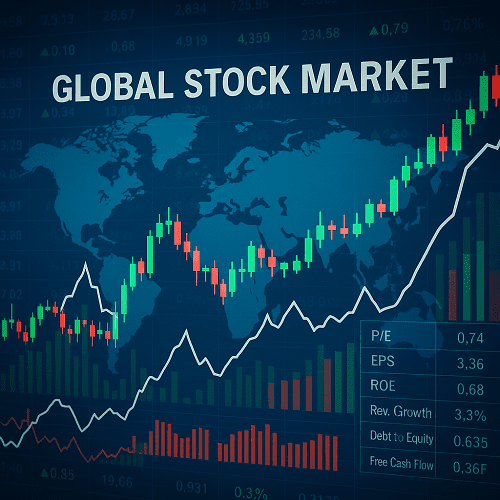
| Metric | What It Tells You |
|---|---|
| P/E Ratio | Market expectations vs. earnings |
| EPS | Profitability trends |
| ROE | Management efficiency |
| Revenue Growth | Competitiveness & demand |
| Debt-to-Equity | Balance sheet strength |
| Free Cash Flow | Real liquidity & stability |
Global Stock Market Forecast for 2025–2026
Base Case: Continued Moderate Growth
- Rate cuts support risk assets
- AI expansion boosts tech sectors
- Corporate earnings stabilize
Bull Case:
- Rapid productivity growth from AI
- Strong global expansion
Bear Case:
- Geopolitical shocks
- Commodity spikes
- Inflation resurgence
Risks to Watch
- Geopolitical conflict
- Debt crises in emerging markets
- Currency instability
- Liquidity withdrawals
- Supply chain disruptions
Conclusion: How to Navigate the Market in 2025
The 2025 stock market offers immense opportunity, but demands disciplined strategy, risk management, and continuous learning. With rapid innovation and shifting macro forces, successful traders combine:
- Deep fundamental insight
- Advanced technical analysis
- Data-driven decision-making
- Global macro awareness
Use the strategies and insights in this guide to outperform, stay informed, and build long-term investment success.

 XAUT-USD
 AMD
AMD JNJ
JNJ MARA
MARA
 SHOP
SHOP UNH
UNH BULL
BULL EURUSD=X
 CL=F
CL=F