




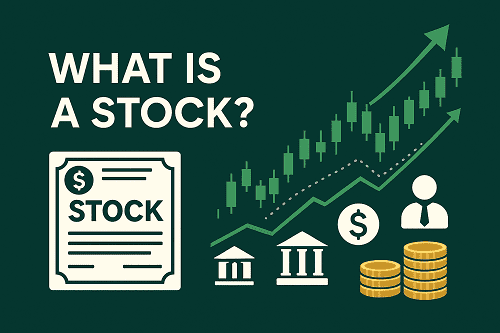
What Is a Stock?
A stock is a financial security representing partial ownership in a company. When you buy a stock, you buy a “share” — a unit of ownership that gives you a claim on the company’s assets, earnings, and voting rights.
In other words:
If the company grows and becomes more valuable, so does your share.
Key characteristics of a stock:
- Represents partial ownership of a corporation
- Trades on public stock exchanges
- Gives shareholders the potential to profit from price increases
- May provide income through dividends
- Typically includes voting rights on major corporate decisions
A stock is not a loan to a company — that would be a bond. A stock is a slice of ownership.
How Stocks Work: Ownership, Rights & Corporate Structure
Owning stock usually gives you:
✔ Voting rights
Most common shareholders can vote on:
- Board of directors appointments
- Corporate policies
- Mergers or acquisitions
- Executive compensation proposals
Votes may occur annually or during special meetings.
✔ A share of earnings (dividends)
If the company distributes profits, shareholders receive dividends according to the number of shares they own.
✔ Residual claim on assets
If a company liquidates, shareholders get what’s left after creditors and bondholders are paid.
✔ Capital appreciation
As the business grows, its stock price may rise — increasing the value of your investment.
✔ Transferability
You can sell your shares anytime through an exchange.
Why Companies Issue Stock
Companies go public through an Initial Public Offering (IPO) to raise capital for growth.
Companies issue stock to:
- Expand operations
- Develop new products
- Pay off debt
- Acquire other companies
- Strengthen financial stability
- Improve public visibility and credibility
Selling stock allows businesses to raise money without taking on debt or paying interest.
How Stock Prices Are Determined
Stock prices change constantly due to supply and demand.
Major factors influencing stock prices include:
1. Company performance
- Revenue growth
- Profitability
- Market share
- Earnings reports
2. Investor sentiment
- Fear and greed
- News events
- Social media buzz
- Industry announcements
3. Economic conditions
- Interest rates
- Inflation
- GDP growth
- Employment data
4. Market liquidity
Higher trading volume usually reduces volatility.
5. Technical trading
Prices also react to:
- Chart patterns
- Support and resistance levels
- Algorithmic trading
- Momentum strategies
Ultimately, price = what buyers will pay and sellers will accept.
How Investors Make Money from Stocks
Investors can profit in two primary ways:
1. Capital Gains
When the price of your shares increases, you can sell them at a profit.
Example:
Buy at $50 → Sell at $80 = $30 profit per share
2. Dividends
Some companies pay regular cash distributions to shareholders, typically quarterly.
Additional profit sources include:
- Stock buybacks, which can boost share prices
- Dividend reinvestment, compounding returns over time
- Covered-call strategies for income investors
Types of Stocks Explained
A well-rounded investor should understand the major stock categories:
By Company Size (Market Capitalization)
- Large-cap (e.g., Apple, Microsoft)
Stable, blue-chip companies with global presence - Mid-cap
Growing companies with strong potential - Small-cap
High growth potential but higher risk
By Growth Characteristics
- Growth stocks
High-potential companies reinvesting profits (e.g., tech firms) - Value stocks
Stocks trading below perceived intrinsic value - Income stocks
High-dividend, stable businesses
By Sector
Examples include:
- Technology
- Healthcare
- Energy
- Consumer goods
- Industrials
- Finance
Diversifying across sectors helps lower risk.
Common vs. Preferred Stock
| Feature | Common Stock | Preferred Stock |
|---|---|---|
| Ownership | Yes | Yes |
| Voting rights | Usually | Rare |
| Dividend payments | Variable | Fixed or priority |
| Price volatility | Higher | Lower |
| Liquidation priority | Lowest | Higher than common |
Preferred stock behaves somewhat like a hybrid between stock and bond.
Stock Market Structure: Exchanges, Indexes & Trading Venues
Major U.S. Stock Exchanges
- NYSE (New York Stock Exchange)
- NASDAQ
- CBOE (Chicago Board Options Exchange)
Other regions include:
- LSE (London)
- TSE (Tokyo)
- HKEX (Hong Kong)
Key Stock Indexes
Indexes measure market performance:
- S&P 500
- Dow Jones Industrial Average (DJIA)
- NASDAQ Composite
- Russell 2000
Index performance often serves as the benchmark for portfolios.
Risks of Owning Stocks
Stocks offer high long-term returns but come with risks:
1. Market risk (volatility)
Prices can rise or fall quickly.
2. Business risk
Poor management or failing products can hurt a company.
3. Economic risk
Recessions, inflation, and high interest rates impact stock performance.
4. Liquidity risk
Some stocks are harder to sell at a fair price.
5. Emotional risk
Investors often damage their returns by reacting emotionally.
How to Evaluate a Stock
To make informed decisions, investors analyze stocks using two approaches.
Fundamental Analysis
This method studies the company’s financial health.
Key metrics include:
- Revenue & earnings growth
- Profit margins
- P/E ratio (price-to-earnings)
- Debt levels
- Free cash flow
- Return on equity (ROE)
Technical Analysis
This method studies chart patterns and price behavior.
Tools include:
- Trendlines
- Support/resistance
- Moving averages
- RSI and MACD
- Volume analysis
Technical analysis helps with timing buy/sell decisions.
Strategies for Investing in Stocks
1. Buy-and-hold investing
Best for long-term wealth creation.
2. Value investing
Buying undervalued companies.
3. Growth investing
Targeting high-expansion firms.
4. Dividend investing
Focusing on steady income generators.
5. Index investing
Buying an index fund to mirror a market’s performance.
6. Dollar-cost averaging
Investing a fixed amount regularly to smooth volatility.
7. Active trading (advanced)
Day trading, swing trading, and options strategies — higher risk, specialized skill required.
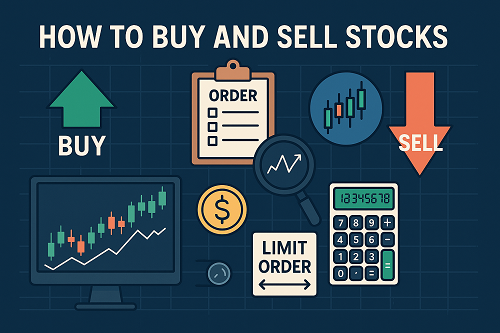
How to Buy and Sell Stocks
Investing in stocks is simple:
- Open a brokerage account
- Deposit funds
- Choose the stock you want
- Select the order type (market, limit, stop)
- Make the purchase
- Monitor your investment or set long-term strategies
Always maintain a diversified portfolio to reduce risk.
Frequently Asked Questions
Are stocks risky?
Yes — stocks fluctuate in value. However, historically they provide the highest long-term returns of major asset classes.
Do all stocks pay dividends?
No. Some companies reinvest profits into growth.
How many stocks should I own?
Most experts recommend 15–30 stocks across sectors — or a diversified index fund.
How long should I hold stocks?
Long-term investing (5+ years) historically produces the most reliable returns.
Final Thoughts
Stocks are powerful tools for building wealth, but understanding how they work is essential. By learning the fundamentals — from ownership rights and price dynamics to evaluation methods and investment strategies — you position yourself to make confident, informed decisions.
 XAUT-USD
 AMD
AMD JNJ
JNJ MARA
MARA
 SHOP
SHOP UNH
UNH BULL
BULL EURUSD=X
 CL=F
CL=F