




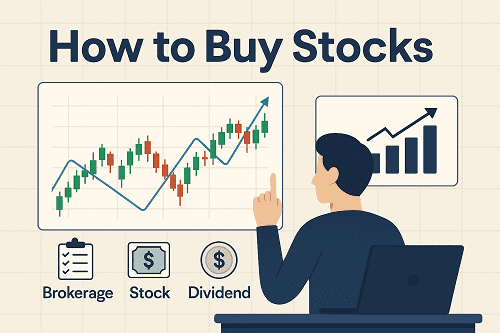
Why Stocks Still Matter in 2025
The stock market remains the single most powerful engine for long-term wealth creation. While forex and crypto have grown dramatically, stocks continue to offer a unique combination of:
- Regulation and stability
- Long-term compounding power
- Access to global companies and innovations
- Passive income through dividends
Historically, broad stock indexes (S&P 500, NASDAQ, TSX) return 7%–10% annually over long periods — outperforming most other asset classes.
What has changed in 2025 is accessibility:
- You can now buy fractional shares.
- Trading fees are near zero.
- AI-powered research and automated tools help beginners invest like professionals.
- Cross-asset platforms allow stocks, ETFs, crypto, and forex in one place.
Whether you’re building wealth slowly or interest in active trading, this guide walks you through everything you need to know from beginner to advanced.
<a name=”how-stocks-make-money”></a>
How Stocks Make Money
Understanding how stocks generate profit is essential before you buy your first share. There are four main ways:
a) Capital Appreciation (The Stock Price Goes Up)
This is the most common source of profit. You buy low and sell high.
Example:
If you buy a stock at $50 and it rises to $70, you earn $20 per share in capital gains.
What drives prices higher?
- Strong earnings growth
- New products and innovations
- Market optimism
- Lower interest rates
- Industry trends
- Higher investor demand
b) Dividends (Cash Paid Out to Shareholders)
Many companies — especially mature ones — pay dividends quarterly.
If a company pays $0.80 per quarter and you own 100 shares, you receive $320 annually.
High-quality dividend stocks offer:
- Passive income
- Lower volatility
- Better long-term returns
- Stability during downturns
c) Share Buybacks (Boosting Share Value Indirectly)
Companies often repurchase their own shares, reducing supply.
Fewer shares = higher ownership percentage per share = higher price over time.
Buybacks also increase:
- EPS (earnings per share)
- Shareholder value
- Long-term growth per share
d) DRIPs (Dividend Reinvestment Plans)
Instead of taking cash dividends, you can automatically reinvest them into more shares.
DRIPs allow compounding to work faster without adding more money yourself.
e) Tax-Efficient Strategies
Depending on your country:
- Capital gains may be taxed lower than income
- Dividend tax credits may reduce tax burden
- Tax-advantaged accounts like TFSA, RRSP, IRA, or 401(k) can help you grow wealth tax-free or tax-deferred
Using the right account can increase long-term returns by 20–40%.
<a name=”how-to-buy-stocks-step-by-step”></a>
How to Buy Stocks Step-by-Step
Buying stocks today is fast and simple. Here’s the exact process.
Step 1: Choose a Brokerage
Look for:
- Low fees
- Fractional shares
- Easy-to-use mobile app
- Pre-built research tools
- Regulated and insured platform
- Access to international markets
- Support for ETFs, crypto, options, forex (optional)
Popular choices include:
- Interactive Brokers
- TD Ameritrade / Schwab
- Wealthsimple (Canada)
- Fidelity
- eToro
- Robinhood
- Questrade
Choose based on your country and investing style.
Step 2: Open the Right Account
Common account types:
Taxable Brokerage Account
- Most flexible
- Can invest freely
- Taxes apply to dividends and capital gains
Retirement Accounts (RRSP, TFSA, IRA, 401(k), etc.)
- Tax advantages
- Contribution limits
- Typically long-term investing
Margin Account (Advanced)
- Allows borrowing to buy stocks
- Higher risk
- Interest fees apply
Step 3: Fund Your Account
You can deposit via:
- Bank transfer
- Wire transfer
- Interac (Canada)
- Debit/credit (rarely recommended)
Most deposits clear within 0–3 days.
Step 4: Place Your First Stock Order
You’ll see these order types:
Market Order
Buys immediately at current price.
Limit Order
Buys only at your chosen price or better — ideal for controlling risk.
Stop Order / Stop-Loss
Automatically sells if price drops to a certain level, protecting your downside.
Trailing Stop
Adjusts as the price rises — powerful for locking in profits.
Fractional Share Purchase
Buy a fraction of expensive stocks (e.g., $25 of Amazon instead of one full share).
<a name=”what-to-look-for”></a>
What to Look for Before Buying Any Stock
This is where we go beyond beginner content. Successful investors analyze stocks using four core pillars:
Pillar 1: Fundamental Analysis (The Company’s Financial Strength)
Key metrics to evaluate:
Revenue Growth
Is the company consistently growing sales?
Earnings Growth
Growing profits signal strong operations.
Profit Margins
- Gross margin
- Operating margin
- Net margin
Higher margins = stronger competitive advantage.
Debt Levels
Look at debt-to-equity ratio and interest coverage.
Return on Invested Capital (ROIC)
One of the strongest indicators of long-term performance.
ROIC over 10% is considered excellent.
Free Cash Flow (FCF)
Cash left after expenses — the lifeblood of buybacks and dividends.
Pillar 2: Valuation (What the Stock Is Actually Worth)
Common valuation tools:
- P/E Ratio (price vs earnings)
- PEG Ratio (growth-adjusted valuation)
- Price-to-Sales (P/S)
- Price-to-Book (P/B)
- EV/EBITDA (enterprise value vs cash earnings)
Compare valuations to:
- Sector averages
- Company history
- Expected growth rate
Pillar 3: Technical Analysis (Price Action & Timing)
Even long-term investors benefit from basic chart reading.
Key indicators:
- Support & resistance levels
- Moving averages (50-day, 200-day)
- RSI (Relative Strength Index)
- MACD
- Volume analysis
These help identify better entry points.
Pillar 4: Qualitative Factors (The Intangibles)
What cannot be measured but matters:
- Industry trends
- Competitive moat
- Regulation
- Management quality
- Brand strength
- Innovation pipeline
- Economic conditions
Some of the world’s best stocks win because of intangible advantages.
<a name=”how-much-to-invest”></a>
How Much to Invest and How Many Stocks Should You Own?
Rule 1: Only invest money you won’t need within 3–5 years.
The stock market fluctuates — avoid short-term pressure.
Rule 2: Diversify across 10–20 stocks.
This reduces risk without lowering returns significantly.
Rule 3: Start small and scale in.
Use dollar-cost averaging (DCA) to reduce timing risk.
Rule 4: Keep speculative trades under 10% of your portfolio.
Crypto, forex, penny stocks, and options should be small allocations.
<a name=”beginner-stock-trading-tips”></a>
Beginner Stock Trading Tips That Actually Work
- Avoid chasing “hot” stocks
- Stick to companies you understand
- Don’t check your portfolio obsessively
- Use limit orders, not market orders
- Ignore social media hype
- Build a long-term mindset
- Learn from losses — they are unavoidable
- Keep emotion out of decisions
<a name=”advanced-strategies”></a>
Advanced Strategies: Momentum, Swing Trading & Thematic Investing
Momentum Trading
Buy stocks that are trending upward on strong volume.
Swing Trading
Hold positions for several days or weeks, buying dips in uptrends.
Thematic Investing
Invest in sectors shaping the future:
- AI
- Semiconductors
- Cybersecurity
- Electric vehicles
- Renewable energy
- Biotechnology
Value Investing (Buffett Style)
Buy undervalued companies with strong fundamentals.
Options for Hedging or Leverage (Advanced Only)
- Covered calls
- Protective puts
- Spread strategies
<a name=”stocks-vs-forex-vs-crypto”></a>
Stocks vs Forex vs Crypto: Which Should You Buy?
Each market has distinct advantages.
| Feature | Stocks | Forex | Crypto |
|---|---|---|---|
| Volatility | Medium | Medium | High |
| Risk | Low/Medium | Medium | High |
| Regulation | Strong | Moderate | Light |
| Long-term growth | Strong | Weak | Very strong but unstable |
| Passive income | Dividends | None | Staking (varies) |
| Best for | Long-term wealth | Active traders | Speculators / high-volatility investors |
Best overall for beginners:
✅ Stocks and ETFs
<a name=”risk-management”></a>
Risk Management: Protecting Your Money
Risk management separates winning investors from gamblers.
Position Sizing
Never risk more than 1–2% of your portfolio on a single trade.
Stop-Loss Orders
Limit your downside automatically.
Diversification
Spread risk across industries and asset classes.
Rebalancing
Adjust holdings periodically to maintain target allocations.
Avoid Leverage (Margin) Until Advanced
Magnifies losses dramatically.
<a name=”glossary”></a>
Important Stock Market Terminology (Expanded Glossary)
Includes:
- Ask price
- Bid price
- Market cap
- EPS
- ETF
- Index fund
- Bull market
- Bear market
- Liquidity
- Volatility
- Leverage
- Spread
- Broker
- IPO
- Short selling
- Yield
(And many more—ask if you’d like a full 200-term glossary.)
<a name=”faq”></a>
Frequently Asked Questions
Is now a good time to buy stocks?
Historically, long-term investing always outperforms waiting for the “perfect time.”
How many stocks should a beginner buy?
10–20 stocks or a diversified ETF is ideal.
Should I buy individual stocks or ETFs?
ETFs are safer for beginners; individual stocks can outperform with more work.
How long should I hold a stock?
Ideally years — the average millionaire investor holds quality stocks for 8+ years.
<a name=”conclusion”></a>
Conclusion + Actionable Checklist
Here’s your quick start checklist:

 XAUT-USD
 AMD
AMD JNJ
JNJ MARA
MARA
 SHOP
SHOP UNH
UNH BULL
BULL EURUSD=X
 CL=F
CL=F