



Quick Snapshot & Key Metrics
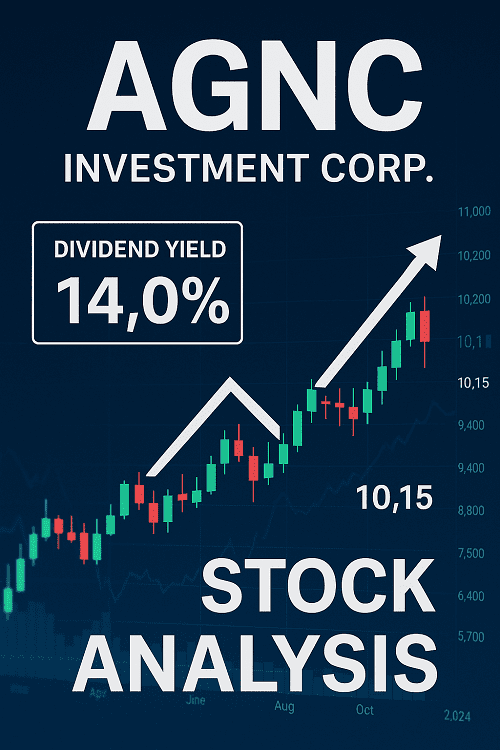
- Dividend yield: ~ ≈ 14% (very high) per several sources.
- Book value/tangible net book value: As of Q2 2025, tangible net book value (TNBV) = $7.81/share (down from $8.25 in Q1).
- Leverage: “At
- Portfolio: ~$82.3 billion investment portfolio (Agency MBS & TBA securities) as of June 2025.
- Analyst consensus: Moderate Buy, but with concerns about near-term downside / dividend sustainability.
Business Model & Why It’s Unique
AGNC is a mortgage REIT (mREIT) focused on agency-backed mortgage-backed securities (MBS). Highlights:
- It primarily invests in fixed-rate agency MBS guaranteed by U.S. government-sponsored enterprises (GSEs) such as Fannie Mae, Freddie Mac, and Ginnie Mae.
- The return driver: The net interest spread between what AGNC earns on its mortgage assets and what it pays to fund those assets (plus some hedging and other income).
- It uses significant leverage to amplify returns (and amplify risks).
- Monthly dividends (income-oriented product) – appealing for yield-seeking investors.
- The business is highly sensitive to interest rates, yield curves, prepayment risk, hedging risk, and regulatory/government-sponsored entity policy.
Key Strengths
- High yield: At ~14% yield, AGNC stands out for income-oriented investors.
- Agency-backing: Because the MBS are agency-guaranteed, credit risk is relatively low compared to non-agency MBS.
- Large size and scale: $80 + bil portfolio gives it scale advantages in funding and hedging.
- Leverage ability: In favorable rate/spread environments, the leverage can generate strong returns.
Major Risks & Weaknesses
- Interest rate/spread risk: If the cost of funds rises or MBS yields compress, the net spread falls (or turns negative). For example, Q2 2025 the net interest spread annualized was 2.01% compared to 2.12% prior quarter.
- Book value erosion: TNBV fell from $8.25 to $7.81 in Q2 2025, a -5.3% quarter drop.
- Leverage amplifies losses: When things go wrong (e.g., yield curve inversion, funding stress), losses are magnified.
- Dividend sustainability: A very high yield often signals elevated risk; payout ratios may become unsustainable if underlying earnings/spread shrink. From MarketBeat: payout ratio very high (~214% by some estimate) which suggests risk of cut.
- Market sentiment & regulatory risk: mREITs often trade based on macro/regulatory developments; hard to predict.
Recent Performance & Financial Highlights
- For Q2 2025 (ended June 30):
- Net loss per common share: $0.17 (basic) vs –$0.11 a year ago.
- Tangible net book value per share: $7.81 as of June 30, down from $8.25 at March 31, 2025.
- Average portfolio asset yield ~4.89% (excluding TBA), cost of funds ~2.86%; net interest spread annualized ~2.01%.
- Return history: Over the past 12 months, the TTM total return ~26.24% (includes dividends) for AGNC according to one source.
Outlook & What to Watch
Catalysts that could help AGNC
- Declining short-term interest rates: If the Fed lowers rates, cost of funds falls → spread widens → positive for AGNC.
- Steepening yield curve: A steeper curve favors longer duration MBS relative to short-term funding, improving spread.
- Tightening supply of agency MBS or stronger demand, which could narrow mortgage spreads to benchmark rates. AGNC management sees this as a positive.
- Efficient hedging and liquidity: AGNC has significant unencumbered cash + MBS (~$6.4 billion) as of June 30.
Risks / headwinds to monitor
- Rising short-term rates or yields: If funding costs increase faster than asset yields, spread compression.
- Flattening/inverting yield curve: Could hurt profitability.
- Prepayment risk: Faster than expected home-refinancing or home‐sales can shorten MBS duration, reducing interest income and may force reinvestment at lower yields.
- Weakening book value: If TNBV keeps falling, shareholders’ downside risk increases.
- Dividend cut risk: High yields come with risk; if performance falters, management may reduce payout.
Valuation & Trading Considerations
- AGNC appears to trade at a premium to book value relative to peers (P/TBV >1) in some metrics. For example one article noted P/TangibleBook ~1.24× vs industry ~0.97×.
- Given the high dividend, much of the return is income-based rather than capital appreciation.
- Short interest is moderate (~6.19% of float) and increasing, indicating some bearish sentiment.
Trading & Investment Strategy Ideas
Here are some ways you might approach AGNC, depending on your risk profile.
For Income-Oriented Investors
- View AGNC as a high-yield income play, but treat it as higher risk than corporate bonds or more traditional REITs.
- Use as part of a diversified income portfolio, not as the sole income asset.
- Monitor dividend announcements monthly: historically has paid ~$0.12/share per month in recent months.
For Traders / Tactical Positioning
- Consider hedge or stop-loss levels due to high volatility.
- Pair trade: Compare AGNC to other agency mREITs (or hedge with those) to isolate spread/funding risk vs broad housing risk.
For Long-Term Investors
- Long-term thesis hinges on expectation of lower funding costs and stable or compressing mortgage spreads. If you believe rates will eventually come down and stay down, AGNC could benefit.
- But be aware: if secular trend is higher rates (for inflation/other reasons), then AGNC may struggle.
- Track book value trend carefully — sustained erosion of book value is a red flag.
Key Metrics Summary
| Metric | Value / Note |
|---|---|
| Price (approx) | ~$10.15/share |
| Dividend Yield | ~14% range |
| Tangible Net Book Value (TNBV) | ~$7.81/share as of June 30 2025 |
| “At-risk” Leverage | ~7.6× TNBV |
| Analyst Consensus | Moderate Buy, limited near-term upside per MarketBeat |
| Payout Ratio Concern | Very high payout ratio, sustainability risk |
My View: Prospects & Recommendation Thoughts
If I were to summarize my view:
- AGNC is compelling for high-yield seekers who are comfortable with significant macro/interest rate risk.
- The premium yield compensates for risk, but that risk is real and non-trivial (book value erosion, leverage, rate/funding risk).
- From a trading perspective, it may offer attractive short-term upside if you anticipate favorable interest-rate moves (e.g., rate cuts, curve steepening).
- From an investment perspective, you’re essentially making a macro-call: “Will funding costs come down / will mortgage spreads narrow?” If yes → upside; if no → downside.
- I would monitor thresholds: if book value falls significantly below some level, or if payout becomes unsustainable, prepare to exit or hedge.
- Because of the risks, this is not a “set-and-forget” dividend stock like a utility or broad REIT. More active monitoring is required.

 XAUT-USD
 AMD
AMD JNJ
JNJ
 MARA
MARA SHOP
SHOP UNH
UNH BULL
BULL EURUSD=X
 CL=F
CL=F